


Famous Vikings certainly wore beards. While beard styles were designed to help deal with the bitter cold weather, a beard was also an important part of the Viking aesthetic. The Vikings also paid a lot of attention to beard care, in order to keep them under control both on the farm and the battlefield.
But what did Viking beards really look like, and how can you grow your own?
What is a Viking beard?
That beards were an important part of how Viking men presented themselves is clear from the numerous bead-related nicknames that appear in the Norse sagas. We hear of Silk-beard, Fork-beard, Gold-beard and many more.
Further, in the Codex Regius, all of the male gods of Asgard, with the exception of Loki, are described as having beards.

The sagas also suggest that not having a Viking beard was problematic. In the Saga of Burnt Njal, the eponymous hero is mocked as being a beardless old man.
While beards were clearly important, beard styles changed over time. Surviving Viking carvings of gods and men show a variety of different beard styles, from long and flowing, to braided beards, to short goatees, to just moustaches. The length and fullness of a Viking beard would also have depended very much on genetics, just like today.
While specific beard styles may have changed over time, beard care and keeping beards clean and tidy was always important. Beard combs are among the small items that men carried with them on their person.
In the story of the death of his son Balder, Odin, also sometimes called Grey-beard, Long-beard or even Drooping-beard, was in such as state of grief that he refused to wash or comb his hair and beard, breaking social norms in his intense distress.

The Vikings took beard care pretty seriously. They would have washed their beards relatively regularly for the time, along with their hair. They then would have used their comb daily to keep their beard neat and maintain their beard style, as well as ensure that their beards were free of dirt, food, bugs and other debris.
The Vikings did style their beards and hair in order to go into battle. Those with long beards would often braid them, into a single braid or multiple braids. This was for the practical purpose of keeping their hair out of their eyes and face. However, as a result, such beard styles would have become part of the Viking warrior aesthetic.
What the sagas actually tell us
The nickname tradition is only the surface. In Norse society, a man's beard was a matter of law as much as aesthetics. The medieval Icelandic legal codes classified pulling another man's beard as a serious insult — one that carried the same weight as drawing a weapon in anger. You could be outlawed for it.
The sagas describe grooming in unexpected detail. Viking men carried combs as standard kit — archaeological finds from graves across Scandinavia confirm this, combs made from antler and bone recovered alongside weapons and tools. The Njáls saga describes Gunnar of Hlíðarendi as a man of exceptional appearance, and his grooming is part of what marks him as someone worth following. Appearance was not vanity — it was signal.
The Codex Regius, which preserves the Eddic poems, describes every male god of Asgard with a beard — with the notable exception of Loki. Whether the poets intended this as a subtle insult to the shapeshifter has been debated by scholars for centuries. What it tells us plainly: a beardless man in Norse culture occupied a different social category. A beard was not an option. It was a statement about who you were and where you stood.
How to grow a Viking beard?
While historically the Vikings may not have had a clear definition of a ‘Viking beard style’, modern culture certainly has. Modern Viking beard styles are long and full, worn natural, or combed and braided and adorned with jewelry. How can you embrace the Viking beard style?
1. Clean your beard
A key word is hygiene. Wash your beard every day. No excuses, unlike in the Viking age, you should have no problem getting your hands on clean water for this. Whether you use a special beard soap or classic shampoo, lather it up and let it rest for 2 minutes so that the hair soaks in and re-hydrates before rinsing thoroughly.

You can then apply a balm or oil to increase the suppleness of the hair and prevent it from breaking and becoming tangled.
As your beard grows, it may be necessary to equip yourself with a small chisel and/or electric mower to control the growth in the style you have chosen.
2. Trimming of the beard
Hair does not naturally grow at an even rate, so without trimming you will be left with an uneven beard and stray long hairs. Keep your beard style in check with regular trimming. Trim while the hair is dry as your beard will sit differently when it is wet.

3 key points:
#1 Always start by combing your beard. This will help to separate the hairs and let you clearly see what needs to be cut.
#2 Do not cut your beard while it is wet. Dry hair sits differently to wet hair and will appear shorter. If you cut your beard when it is wet, you may end up with an uneven line.
#3 Remember to cut the circumference of the throat. This area is very often forgotten, because it is usually hidden under the mass of your beard! But make sure you keep it clean and uniform. This will greatly reduce itching and give a clean appearance and finished look.
3. Let your beard grow
Growing a long Viking beard takes patience, and there is little that you can do except wait. Exactly how long it will take depends on your hair, and the length and beard style you want. You should probably expect to wait at least 8 weeks to grow a hearty Viking beard.
To encourage growth the beard, like the hair, nails and all the cells in our body, needs to be nourished. This is not just on the outside with oils and creams....
4. Eat for healthy hair
A variety of foods will encourage hair to grow faster and healthier.
Get healthy fats from fatty fish, avocados and eggs. There are also lots of hair benefitting compounds in berries, nuts and seeds. These also featured in the Viking diet.
We're talking here about feeding you properly, to make your beard grow quickly and strong. The funny thing is that it goes with a sportsman's diet, so you can kill two birds with one stone! To have the beard and body of a Viking warrior! (as long as you do a lot of sports, we agree...)

Proteins are the key. If you want to promote the growth of your beard, you will have to eat a lot of protein. It can be dried fruits, white meat, fish and also red meat, but not too much...
5. You'll have to be patient
You can eat well, lather your beard with oil and massage your skin regularly to promote growth, but there is no escaping that growing an impressive beard takes time. Patience is a Viking warrior virtue too, and it will be useful to you in the quest to grow your epic beard!

It is important to understand that hair growth is not an exact, measurable and predictable science. You won't be able to say, "My beard grows 1cm a month so in 18 months I'll have Ragnar's beard in season 4 of Vikings"
Anyway, it's going to grow and month after me you're going to refine your pure Viking style, you can be sure of that!
Viking beard Long or short ?
The Viking beard was not necessarily a long beard, even if the long beard is what dominates in popular representations of Vikings.
Largely thank to the influence of modern culture, a shorter beard will give a wiser and more neat appearance. I is up to you to decide, based on the shape of your face, what suits you best. Plus, it will always be possible to let it grow later on!

You can amplify your Viking style by letting your beard grow, which again will require quite a bit of time and effort. But long hair can give a distinctive Viking flavor to even the shortest beards.
Viking beard styles — then and now
There was no single "Viking beard." The sagas and archaeological record suggest variety — shaped by personal taste, practical necessity, and the status a man wanted to project. Here are the styles most associated with the Norse tradition, and what they meant.
The full beard
Long, dense, worn naturally or combed straight. The baseline of Viking masculinity — the beard you grew when you were not trying to make a specific statement, just existing fully as a Norse man. Most representations of Odin and Thor fall into this category. It requires patience more than technique: let it grow, keep it clean, keep it shaped at the throat.
The forked beard
Split at the chin into two distinct points, sometimes braided. Sweyn Forkbeard, King of Denmark and father of Cnut the Great, wore his as a marker of identity so distinctive it became his name. This is a deliberate style — it requires regular shaping to maintain the separation and keep the fork symmetrical. Among the most recognizable Viking looks in the historical record.
The braided beard
Practical in origin — a long beard braided and secured kept hair out of a warrior's face and away from a blade's reach. In practice it became something more: a braid is a deliberate act, a signal of intention. Braiding also creates the natural anchor points for beard beads, which is how ornamentation and function became inseparable in Viking grooming culture.
The Viking goatee
Longer hair at the chin, sometimes braided to a point, with the cheeks kept shorter. A practical style for men who wanted the weight of a beard without the full commitment of facial coverage. Common in modern Viking aesthetics — Ragnar Lothbrok's ducktail variant is the most recognizable contemporary version, though the underlying shape has older roots.
The short Viking beard
Not every Norse man wore a saga-length beard. Traders, craftsmen, and ship captains in warmer climates often wore shorter, well-defined styles — neat enough to signal grooming without the full ceremonial weight of a warrior's beard. The key difference from a modern corporate beard: the Viking version was never apologetic. Dense, shaped, intentional.
Vikings take care of their beard and hair
While it is commonly thought that the Vikings were violent and dirty warriors, this does not seem to be historically accurate. Many comtemporary sources commented in the care that both men and women took of their hair.
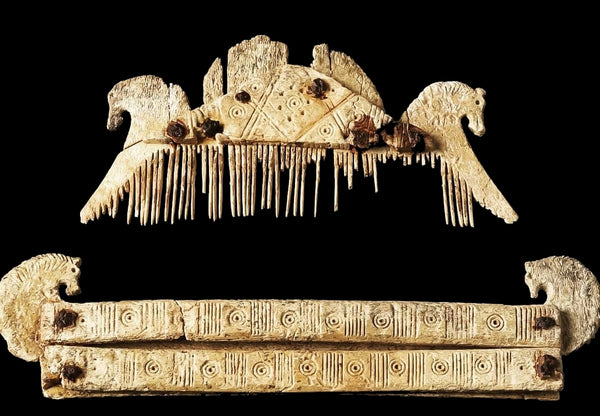
Bone beard comb with its case found in Viking tomb
The chronicles of Eglishman John of Wallingford report that Danish Viking men managed to overcome the virtue of married women and even the young daughters of noblemen with their clean hair and habit of bathing and changing their clothes every saturday. Women couldn't resist them!

Different styles of Viking Beard in 2026
How exactly you style your Viking beard depends on the look that you are going for. If you decide to go for a longer beard style, braids are a great way to make your beard distinctively Viking. If your beard is relatively thin, you might consider a single braid starting at your chin.
If your beard is thicker, two or three braids offer a distinctive beard style. There is also no need to braid the whole beard if you want to keep the fullness. Try two thin braids starting at the corners of your mouth.
The Braided Viking Beard
The braided beard is probably the most caricatured and representative version of a Viking beard.
One or more well-made braids are a thing of pure beauty. There are different ways to braid your beard:
- A single thick and massive braid
- Two or three medium braids
- One or more small braids
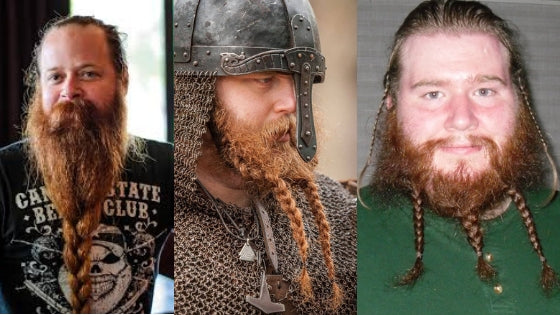
Of course, the first factor that will determine your choice will be the size of your beard, because the first two styles require a thick, long beard.
Small braids can be made after just a few months of growth. While large braids only really work on the cheeks and chin, small braids can be made with the moustache.
Let's be clear, this is not an exhaustive list, the only limit is your imagination! Mix and match braids to create your own distinctive Viking style.
The Beaded Viking Beard

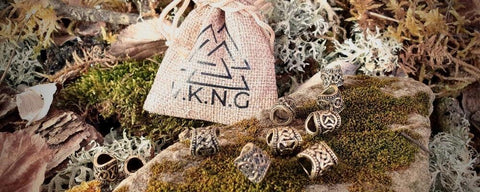
The Vikings often ornamented their beads with small beads, and bead onaments can go a long way towards creating a distinctive Viking style.

This kind of ornamentation also allows you to incorporate other elements of the Viking culture that inspire you into your style. For example, you can use beads inscribed with the runes that are most meaningful to you, or that depict important Viking motifs such as Mjolnir of the Helm of Awe.
Beads can be used as individual decorations, or to hold braids in place.
Other Viking beards style:
Natural Viking Beard

Go for a simple beard style and let the hair stay in its natural state. The key to keeping it looking good is regular grooming.
Short Viking Beard

Choose a shorter beard style that gives full coverage on the face but does not extend too far down the neck, especially if you have tattoos to show off.
Viking Stubble Beard

While just stubble won’t qualify as a Viking beard, a full but short beard that adds shadow and definition to the face is Viking worthy. This is the Viking beard style equivalent of a 5 o’clock shadow.
Viking Moustache Beard

Go for a beard style that emphasizes the moustache as separate from the beard by waxing and curling the moustache ends.
Viking Goatee Beard

If your facial hair grows unevenly, or you simply prefer this beard style, Vikings probably also occasionally sported impressive goatees as a variation on the fuller beard style.
Viking Beard without Moustache

Or loose the moustache all together for a distinctive and memorable beard style.
Extra Long Viking Beard

Go extra long for a more impressive Viking beard style, but remember that this takes years of commitment.
Braided Viking Beard

Keep longer Viking beard styles neat and under control by holding hair together with braids. The Vikings themselves are often depicted as gathering their beards into multiple different braids to create a different beard style.
Decorative Braided Beard

It is also not necessary to braid the whole beard. Smaller braids add character to a full Viking beard, and are a good way to add decorative jewelry.
Frequently asked questions
How long does it take to grow a Viking beard?
A full Viking beard — long enough to braid and adorn — typically takes twelve to eighteen months of uninterrupted growth, depending on genetics and growth rate. The average man grows approximately half an inch of facial hair per month. At six weeks you have enough for a defined short beard. At four to six months, enough for a Viking goatee or short forked style. A braid that holds a bead requires at least three to four inches — roughly six to eight months of growth on the chin. The full warrior length is a year or more. There is no shortcut to this. Minoxidil can stimulate growth in patchy areas, but the timeline for length is biological.
Did Vikings actually braid their beards?
The evidence is indirect but consistent. The Norse sagas describe braided hair in detail, and the same braiding traditions almost certainly extended to beards among men who wore them long. More concretely, the archaeological record has produced bone and antler combs from Viking burials — tools designed for maintaining and shaping long facial hair, not just scalp hair. Beads recovered in contexts suggesting personal adornment also point toward beard and hair use. No surviving image shows a clearly braided beard in photographic-quality detail, but the practice aligns with everything we know about how the Norse approached grooming: deliberately, with care, and with symbolic intent.
What beads did Vikings wear in their beards?
Archaeological finds from Viking-age sites include glass beads (often imported from the Middle East and continental Europe via trade routes), amber beads from the Baltic, bone and antler beads made locally, and forged metal beads and rings. The most common shapes were simple tubes and rings that could be threaded onto braided hair or beard sections. Engraved symbols — runic inscriptions, animal motifs, geometric patterns — appear on metal examples. In the Norse symbolic vocabulary, the choice of symbol carried meaning: protection, guidance, prosperity, allegiance to a specific deity.
What is the difference between beard beads and hair beads?
Functionally, the same bead can be used in both beard and hair — what matters is the bore size relative to the thickness of the braid you're threading through it. Viking-style beads designed for beard use tend to have a slightly wider bore (3–6mm) to accommodate the coarser texture of facial hair. Hair beads can be narrower. Most of our Viking bead collection is sized to work in both beard and scalp hair braids. If you are threading into a thick beard braid, check the bore diameter before ordering.
Should I oil my beard before or after threading beads?
Before. Beard oil applied to a clean, dry beard makes the hair more pliable and easier to braid tightly. A well-oiled braid passes through a bead opening with less friction and holds its shape better once the bead is in place. Apply oil, comb through, braid the section, then thread the bead. Avoid applying oil directly to the bead itself on metal beads, this can cause the surface to tarnish faster and makes the bead harder to grip.
5 comments
Helpful
Great article! Although I must stress some criticism about rule #3 above: “Remember to cut the circumference of the throat.” Trim it, sure, and let it blend seamlessly with your beard. But don’t shave it and make a clear shaven beard line! That strongly signals you look in the mirror each and every day while contemplating the look of your beard. That’s not the viking way but instead the hipster one.
Sure, vikings did put more care in grooming and hygiene than might be suggested by their lifestyle, but there’s limits. When mirrors become a daily ritual and you look way too polished all the time, your viking brethren would surely point that out with words that surely would make this post banned in this day and age.
Muchas gracias. ?Como puedo iniciar sesion?
EPIC! THANKS FOR SHARING!
Unless you are generating a lot of sweat or dirt in your beard everyday, please please please do not wash your beard everyday. Your face does not create enough sebum oil for this. You will dry yourself out leading to a lot of itching and an unhealthy beard. Also, please do not use head hair shampoo and conditioner on your beard. You face skin and face hair is dramatically different than the skin and hair on the top of your head.